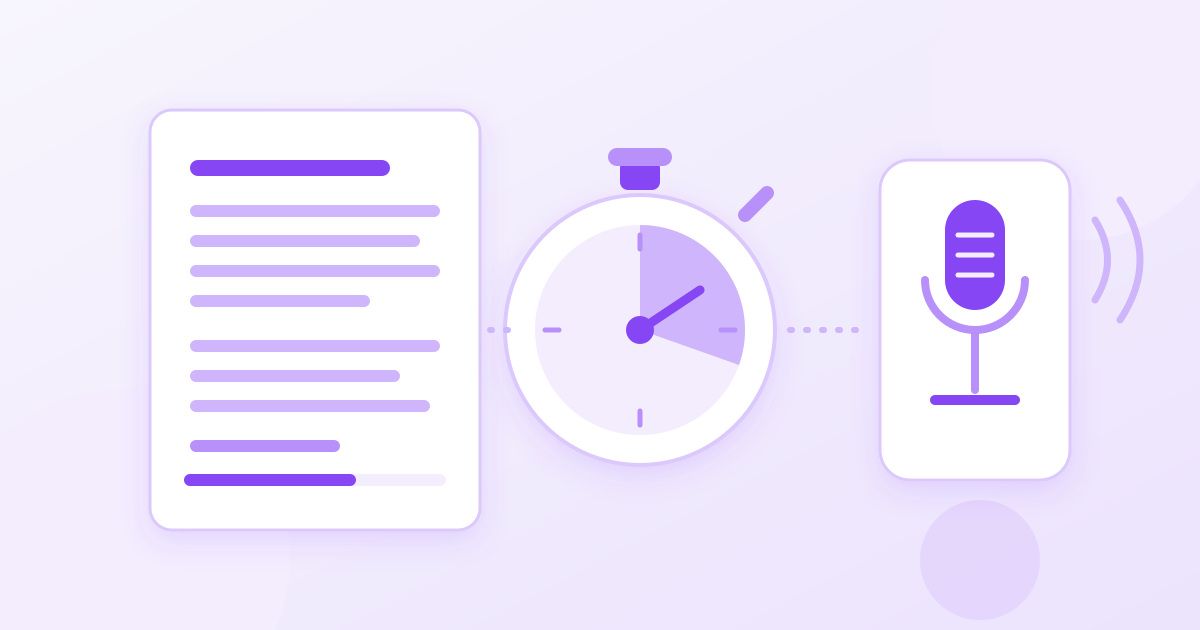
A 5-minute speech is roughly 650 words at a comfortable presenting pace of about 130 words per minute. Depending on how fast you talk, the honest range is 550 to 750 words: closer to 550 if you speak slowly and pause a lot, closer to 750 if you are naturally quick.
That single number gets you started, but the reason so many speeches run long is that people time their script by reading it silently. Silent reading is far faster than speaking aloud, so a draft that "feels" like five minutes on screen often takes seven at the podium. Below is a chart for every common speech length, a way to find your own speaking rate in two minutes, and a simple workflow for cutting a script down to time.
How many words per minute do people actually speak?
Most people speak somewhere between 110 and 160 words per minute when they are presenting. Everyday conversation tends to be quicker, but a speech in front of a room naturally slows down: you pause for emphasis, wait for laughter, glance at notes and breathe. Experienced speakers deliberately sit near the lower-middle of that range because pauses help the audience follow.
- Slow, deliberate (about 110 wpm): eulogies, wedding toasts with emotional moments, speaking in a second language, or a large hall with an echo.
- Typical presenting pace (about 130 wpm): class presentations, business updates, conference talks.
- Brisk (about 150–160 wpm): confident speakers covering familiar material, pitch competitions with hard time limits.
If you do not know your pace yet, plan for 130. It is the safest middle ground and leaves a little room for nerves, which usually speed people up rather than slow them down.
Speech length to word count chart
Use this table to set a word budget before you write. The middle column is the one to aim for unless you already know you speak slowly or quickly.
| Speech length | Slow (110 wpm) | Average (130 wpm) | Fast (150 wpm) |
|---|---|---|---|
| 1 minute | 110 words | 130 words | 150 words |
| 2 minutes | 220 words | 260 words | 300 words |
| 3 minutes | 330 words | 390 words | 450 words |
| 5 minutes | 550 words | 650 words | 750 words |
| 7 minutes | 770 words | 910 words | 1,050 words |
| 10 minutes | 1,100 words | 1,300 words | 1,500 words |
| 15 minutes | 1,650 words | 1,950 words | 2,250 words |
| 20 minutes | 2,200 words | 2,600 words | 3,000 words |
The arithmetic is simple enough to do for any length: minutes × your words per minute = word budget. A 4-minute slot at 130 wpm is 520 words; a 12-minute talk is about 1,560.
If you have been given a range rather than a hard limit ("four to six minutes"), write to the middle of it. Short speeches are rarely criticised for finishing thirty seconds early, while running over a strict slot at a wedding, a competition or a conference can mean being cut off before your best line.
Find your own speaking rate in two minutes
A chart is an average. Your real pace is what matters, and it is easy to measure:
- Take a paragraph or two of your draft (or any text you have not memorised).
- Stand up and read it aloud at the volume and pace you would use in the room. Do not mumble it at your desk; that is faster than real delivery.
- Time yourself for exactly one minute with your phone's stopwatch and mark where you stopped.
- Paste the part you read into the Toolyfied Word Counter to get the exact number of words. That number is your words per minute.
Repeat it once more and average the two runs. Now multiply by your time limit and you have a word budget that fits you, not a hypothetical average speaker.
Why silent reading time misleads you
Reading silently, most adults move through text much faster than they could ever say it aloud. That is why a script can seem short on screen and still overrun. Three other things eat time that a word count does not show:
- Pauses and reactions. A laugh line or a rhetorical question can take several seconds before you continue.
- Slides and props. Switching slides, pointing at a chart or playing a short clip all happen while you are not speaking.
- Numbers and names. "2,450" is one word in a counter but several when spoken ("two thousand four hundred and fifty"). Dense figures slow you down.
As a rule of thumb, if your speech has a lot of audience interaction or slides, budget around 10 percent fewer words than the chart suggests.
How to cut a speech down to 5 minutes
Most first drafts come in long. Trimming is easier when you track the number as you go, so keep the word counter open in another tab and paste your draft in after each pass. It shows words, characters, sentences and paragraphs live, so you can see each cut land.
- Cut the warm-up. "Thank you so much for having me, it is a real pleasure to be here today" is sixteen words before you have said anything. One short line of thanks is plenty.
- Keep one example per point. If you have two stories that make the same point, keep the stronger one.
- Turn lists into a highlight. Five reasons become the two that matter most, with a quick mention that there are others.
- Shorten long sentences. Long sentences are harder to say and harder to follow. Splitting them rarely adds words and often removes some.
- Read aloud again. Time the new version standing up. If you are within 15 seconds of the limit, leave the rest as breathing room.
Word counts for common speech situations
Here is how the numbers play out for the speeches people most often have to write:
| Situation | Typical time | Word target |
|---|---|---|
| Wedding toast (best man, maid of honour) | 3–5 minutes | 400–650 words |
| Class presentation | 5 minutes | 600–700 words |
| Eulogy | 5–7 minutes | 550–850 words (slower pace) |
| Job interview presentation | 10 minutes | 1,200–1,300 words |
| Elevator pitch | 30–60 seconds | 70–130 words |
For emotional speeches such as a eulogy or a toast to someone close, assume you will go slower than usual. Plan for the low end of the range.
Turning your script into notes and handouts
Once the text is the right length, a few practical steps help on the day:
- Print-friendly notes. If you wrote the speech in Word, a Word to PDF conversion keeps your font sizes and line spacing fixed, so the page you rehearsed with is the page you hold.
- Slides to send afterwards. If the talk had a deck, organisers often ask for it. Converting it with the PPT to PDF converter gives a file anyone can open, with the layout preserved.
- Sharing a recording. If someone recorded your speech on a phone, the file can be large. The video compressor shrinks it so you can send it to family or colleagues.
A quick checklist before you deliver
- Your word count sits within your own budget (minutes × your words per minute).
- You have timed at least one full run-through aloud, standing.
- You know which paragraph you will drop if you start running over.
- Numbers, names and hard-to-say words are marked so you do not stumble.
- You have left a few seconds at the end so the last line does not get rushed.
Word count is only a planning tool, but it is the most reliable one you have before you can rehearse. Set the budget first, write to it, and use the timer for the final check.
Frequently Asked Questions
How many words is a 5-minute speech?
About 650 words at an average presenting pace of 130 words per minute. If you speak slowly, aim for around 550 words; if you are a fast speaker, up to about 750 words will fit.
How many words is a 3-minute speech?
Roughly 330 to 450 words, with about 390 words as a good target for an average pace. Toasts and short class presentations usually fall in this range.
How many words per minute is a normal speaking pace?
For presentations, most people speak somewhere between 110 and 160 words per minute, and 130 is a sensible planning figure. Casual conversation tends to be faster than a speech delivered to a room.
How do I know how long my speech will take?
Count the words in your script, then divide by your speaking rate. To find your rate, read aloud for one minute, paste what you covered into a word counter, and use that number as your words per minute.
Does the word counter show speaking time?
The Toolyfied Word Counter shows words, characters, sentences and paragraphs. It does not estimate speaking time, so divide the word count by your own words-per-minute figure to get the time.
Is 1,000 words too long for a 5-minute speech?
Yes, for almost everyone. At 130 words per minute, 1,000 words takes close to eight minutes, so you would need to cut around a third of the script to fit a five-minute slot.