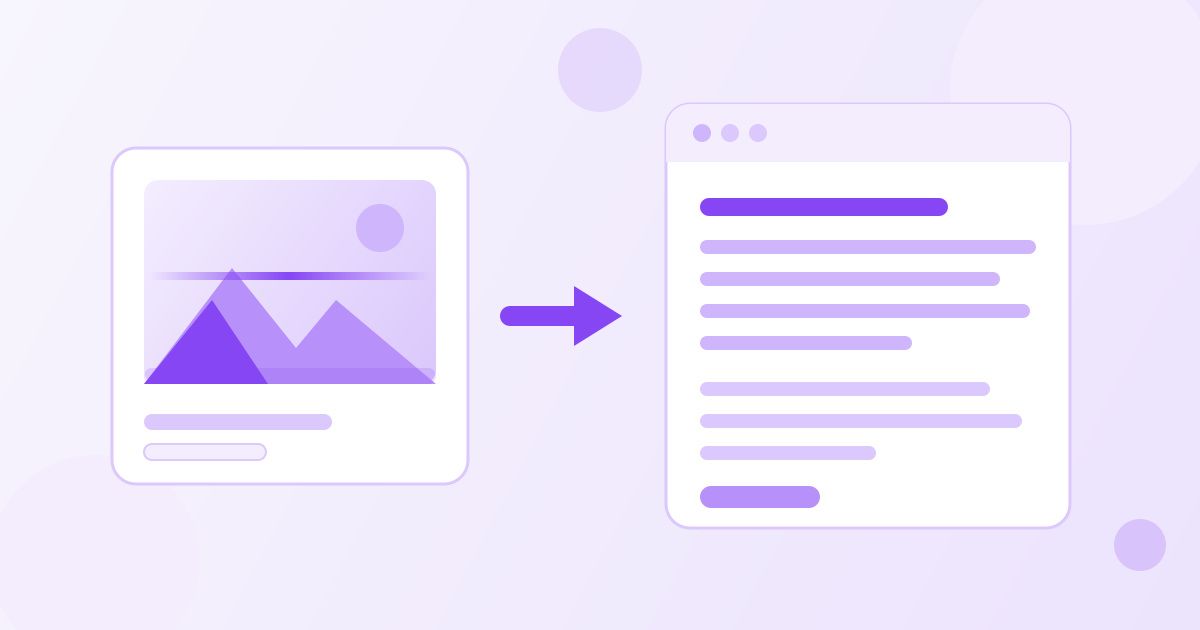
You have a photo of a page, a screenshot of a table, or a scan someone emailed you, and the text inside it is stuck. You cannot select it, cannot search it, cannot paste it into a document. Retyping is the obvious answer and the worst one. OCR does the job in a few seconds instead.
OCR stands for optical character recognition: software looks at the shapes in an image and works out which letters they are, then hands you back plain, selectable text. To do it now, open Toolyfied's Image to Text tool, upload your photo, screenshot or scanned PDF, and copy the extracted text or download it as a .txt file. It is free, needs no account, and adds no watermark. The tool reads English text.
The rest of this guide is about the part nobody explains: why some images come back perfectly and others come back as gibberish, and what to change so yours lands in the first group.
When extracting text from an image is worth it
The obvious case is a document you only have as a picture: a scanned contract, a receipt, a form a colleague photographed on their phone. But the everyday uses are smaller and more frequent than that:
- A screenshot of an error message you want to paste into a search box or a ticket instead of retyping a long code.
- A slide from a presentation where the speaker's notes are burned into the image.
- A page from a book or a printed report you need to quote accurately.
- Handwritten-looking invoices, price lists or menus that arrived as photos and need to go into a spreadsheet.
- A scanned PDF that your PDF reader refuses to search, because there is no text layer in it at all — only pictures of pages.
In each case the alternative is manual typing, which is slow and introduces its own typos. OCR gets you a draft you only have to proofread.
How to extract text from an image, step by step
- Open the Image to Text converter.
- Upload the image — JPG, PNG or WebP — or a scanned PDF.
- Wait while it processes. A single phone photo is usually a few seconds; a long multi-page scan takes longer.
- Read the result. Copy it straight to your clipboard, or download it as a .txt file if you would rather paste it into Word, Google Docs or a spreadsheet later.
- Proofread. OCR is very good, not perfect — see the accuracy section below for the characters it most often gets wrong.
There is no sign-up step, no email wall and no watermark stamped across your text. Files you upload are used to produce the result and old uploads are cleaned off the server automatically every day.
What kind of image gives a good result
OCR accuracy depends almost entirely on the picture you feed it. The engine is trying to match shapes; anything that blurs, warps or breaks up those shapes costs you characters. This table covers the cases people actually hit:
| What you are uploading | Typical result | What to do first |
|---|---|---|
| Screenshot of text on a screen | Near perfect — crisp pixels, straight lines, even contrast | Nothing. This is the ideal input. |
| Flatbed scan of a printed page | Very good | Nothing, if the page was straight on the glass. |
| Phone photo of a page, held flat and lit well | Good | Crop away the desk and background before uploading. |
| Phone photo at an angle, with a shadow across it | Patchy — dropped words, invented characters | Retake it square-on with the light behind you. |
| Low-resolution or heavily compressed image | Poor — letters merge into blobs | Find the original file rather than a messaging-app copy. |
| Handwriting | Unreliable | OCR is built for printed type; expect to retype cursive. |
| Text over a photo or a busy background | Mixed | Crop to the text block so the background is excluded. |
Two practical rules follow from this. First, always send the original file, not a version that has been through a chat app — messaging apps recompress images hard, and that compression is exactly what destroys letter edges. Second, crop before you upload. Cutting the image down to just the text block, using the image cropper, removes furniture, fingers and page edges that the engine would otherwise try to interpret.
Fixing an image that comes back as gibberish
If your first attempt returns nonsense, do not give up on the file — adjust it and try again. In rough order of how often it helps:
- Crop tightly. One column of text, nothing else. Two columns often interleave into a single scrambled paragraph, so crop and run each column separately.
- Straighten it. Text that runs diagonally across the frame is much harder to read than text that runs along the horizontal. Retaking the photo is faster than fighting the file.
- Check the size. Very small images have too few pixels per letter. If the text occupies only a small part of a large image, cropping already fixes this; if the whole file is tiny, look for a better source. The image resizer changes pixel dimensions, but scaling a blurry image up cannot invent detail that was never captured.
- Improve the lighting, not the file. A second photo taken next to a window beats any amount of post-processing on a dim one.
Extracting text from a scanned PDF
A scanned PDF is a PDF that contains pictures of pages rather than text. You can tell instantly: try to select a sentence, or press Ctrl+F and search for a word you can plainly see. If nothing selects and nothing is found, there is no text layer.
You can send a scanned PDF straight to the Image to Text tool and get the text out. If a specific page is the only one you need, or the document is long and awkward, it can be easier to turn the pages into images first with the PDF to JPG converter, then run only the page you care about. That also gives you the chance to crop that page before the OCR step.
The reverse direction is worth knowing too: once you have a clean image of a document, the Image to PDF converter turns it back into a proper PDF for sending or filing.
The English-only limit
Toolyfied's OCR reads English text. Feed it French, Spanish, Arabic, Chinese or any other script and the output will not be usable — it is not a translation tool and it is not a multilingual reader. This matters most with documents that are mostly English but carry accented names, foreign addresses or a quoted phrase in another language: the English body will come through fine, and those specific fragments are where errors will cluster.
It is better to know this before you upload a 40-page scan than after. If your document is not in English, this is not the tool for it.
Always proofread the output
Even on a clean scan, a handful of character pairs trip up every OCR engine, and they are the same ones every time. Skim for these before you use the text anywhere it matters:
- The digit 0 and the letter O; the digit 1, lowercase l and capital I.
- rn read as m, and cl read as d.
- Decimal points and commas in numbers — a misread separator in an invoice is an expensive kind of typo.
- Line breaks in the middle of sentences, especially where the original had a hyphenated word split across two lines.
Anywhere the numbers matter — invoices, bank statements, meter readings, dosages — check every figure against the image rather than trusting the extraction. This is general guidance rather than legal or financial advice; for a document with legal weight, the original scan stays the record, not your text copy.
What to do with the text once you have it
Downloading a .txt file is usually just the first step. Paste it into a document and it becomes editable and searchable. Paste it into a spreadsheet, split on the separators, and a photographed price list becomes real rows. If you are working to a limit — a form field, an abstract, a product description — the word counter gives you live word and character counts on the pasted text without leaving the browser.
If you also need to keep the original image around and it is large, run it through the image compressor before you archive or email it. A phone photo of a document is often several megabytes for no good reason.
A note on the files you upload
Extraction happens on Toolyfied's server, so the image is uploaded to be processed. It is used only to produce your text, and old files are cleared from the server automatically every day. Use your judgement with genuinely sensitive material — an ID document, a medical record, a signed contract — the same judgement you would apply before uploading it anywhere else online.
For everything else, this is one of those tasks where the manual method costs twenty minutes and the tool costs twenty seconds. Crop first, upload the original file, proofread the numbers, and you will get a usable result on the first try.
Frequently Asked Questions
How do I extract text from an image for free?
Upload the image to Toolyfied's Image to Text tool and it returns the text in a few seconds. You can copy it to your clipboard or download it as a .txt file. There is no account to create, no watermark and no cost.
What image formats work for OCR?
JPG, PNG and WebP images all work, and so do scanned PDFs. Whatever the format, the sharpness of the image matters far more than which format it is saved in — a crisp PNG screenshot and a crisp JPG scan give equally good results.
Why is the extracted text wrong or full of nonsense?
Almost always the input image, not the tool. Blur, low resolution, shadows, an angled photo or a busy background all break the letter shapes the engine matches against. Crop to just the text block, retake the photo square-on in good light, and use the original file rather than one that has been through a messaging app.
Can it read handwriting?
Not reliably. OCR is built for printed and typed text, where letter shapes are consistent. Neat block capitals sometimes come through, but cursive handwriting generally does not, and you should expect to type it yourself.
Does it work on languages other than English?
No. Toolyfied's Image to Text tool reads English text only. Documents in other scripts will not extract usefully, and it does not translate anything — it only reads what is in the picture.
Can I get text out of a scanned PDF that will not let me search it?
Yes — that is exactly the scanned-PDF case. A PDF you cannot select or search contains pictures of pages rather than text. Upload it to the Image to Text tool, or convert the pages to images first with the PDF to JPG converter if you only need one specific page.