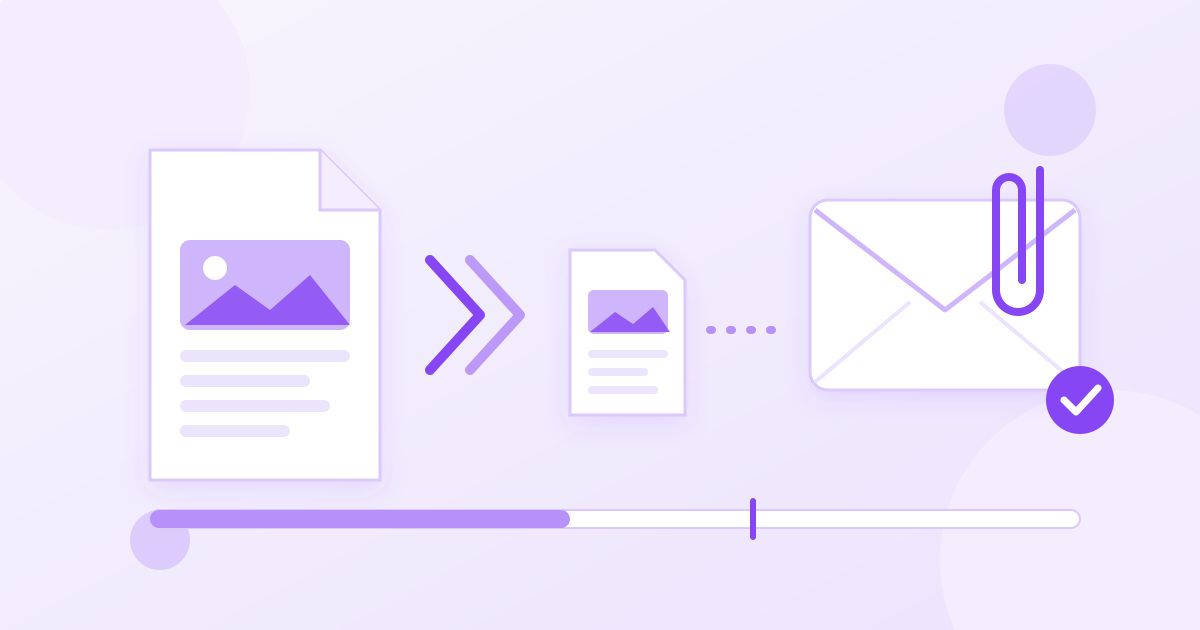
The standard email attachment size limits are 25 MB in Gmail and Yahoo Mail and 20 MB in Outlook.com and iCloud Mail. Those numbers cover the whole message, not each file, and attachments grow by roughly a third when they are encoded for sending, so a file that looks like 20 MB on your computer can already be too big. The reliable fix is to make the file smaller before you attach it, or send a link instead.
This guide gives you the limits side by side, explains why a file under the limit still bounces, and shows the quickest way to shrink each common file type so it goes through on the first try.
Email attachment size limits by provider
These are the limits for personal accounts. Work and school accounts on Google Workspace or Microsoft 365 are set by the organisation's administrator, so they can be higher or lower; if you send from a company address, ask IT rather than assuming.
| Provider | Sending limit | Receiving limit | What happens when you go over |
|---|---|---|---|
| Gmail | 25 MB | Up to 50 MB | Gmail offers to upload the file to Google Drive and sends a link |
| Outlook.com / Hotmail | 20 MB | 20 MB | Outlook offers to share the file from OneDrive instead |
| Yahoo Mail | 25 MB | 25 MB | The attachment is refused |
| iCloud Mail | 20 MB | 20 MB | Apple Mail can send it with Mail Drop (a download link, up to 5 GB) |
One detail catches people out: the smaller limit wins. If you send a 22 MB message from Gmail to someone on Outlook.com, Gmail will happily send it and Outlook will bounce it, because 22 MB is over what it accepts. When you do not know the recipient's provider, aim for something comfortably under 20 MB in total.
Why a file under the limit still bounces
Email was designed for text. To carry a PDF or a video, your mail app converts the file into text using an encoding called Base64, and that conversion makes it roughly 33% larger. The provider measures the encoded size, not the size you see in your file manager.
In practice that means:
- A 25 MB limit fits files of about 18 MB once encoding is counted.
- A 20 MB limit fits about 14–15 MB of attachments.
- Several attachments add up. Three 6 MB photos are 18 MB before encoding, which is already too much for Outlook.
- The message body counts too, including pasted images and long email signatures with logos.
So if Gmail rejects a "24 MB" file, it is not being inconsistent. The file is simply about 32 MB by the time it is ready to send.
How to get each type of file under the limit
Which fix works depends on what you are sending. The table below is the short version; the sections after it go through each one.
| File | Fastest fix | What you give up |
|---|---|---|
| PDF (scans, reports) | Compress it, or send only the pages needed | Some image sharpness in scanned pages |
| Video | Compress it, or trim it to the part that matters | Some detail; trimming loses nothing in what you keep |
| Phone photos | Compress or resize them | Pixels you would not see in an email anyway |
| PowerPoint | Convert to PDF if they only need to read it | Editing and animations |
| Audio recordings | Convert WAV to MP3 | A little audio quality, rarely noticeable for speech |
PDFs
Large PDFs are almost always large because of images: scanned pages, photos or high-resolution charts. Running the file through the PDF Compressor reduces the size while keeping the text readable, and scanned documents usually shrink the most. If the person only needs part of a long document, the PDF Splitter lets you pull out a page range (for example pages 1–3 and 7) into a new, smaller file. You can also split a very large report into two files and send them in two emails.
Videos
Video is the file type most likely to blow through the limit: a minute of phone footage can easily be well over 20 MB. The Video Compressor handles MP4 and MOV files and adds no watermark. If the clip is longer than it needs to be, cut it first: trimming a two-minute video down to the 30 seconds that matter does more than any compression setting. For anything longer than a short clip, a cloud link (Google Drive, OneDrive, iCloud) is honestly the better choice, because a heavily compressed video loses too much detail.
Photos
Modern phones take photos of several megabytes each, far more pixel detail than anyone needs on a screen. The Image Compressor shrinks JPG, PNG and WebP files a lot with little visible change. If you need a specific size, for example 1600 pixels wide for a document or a form, resize first and then compress. iPhone photos in HEIC format are worth converting to JPG too, since not every recipient can open HEIC on Windows.
PowerPoint presentations
Presentations get heavy because of embedded photos, video and fonts. If the recipient only needs to read the slides, converting them with the PPT to PDF Converter keeps the layout and usually produces a smaller file, which you can compress further as a PDF. If they need to edit it, compress the images inside PowerPoint or share a link.
Audio
Uncompressed WAV recordings take up about 10 MB per minute in CD quality. Converting them to MP3 with the Audio Converter brings that down sharply, and for interviews, voice memos and meetings the difference in sound is hard to hear.
A quick routine before you hit send
- Add up the attachments. Check the size of each file and the total.
- Multiply by 1.37. That is a safe estimate of the encoded size. If the result is under 20 MB, it will reach any of the big providers.
- Shrink the biggest file first. One video or scanned PDF is usually most of the weight.
- Split across emails if needed. Two messages of 12 MB each arrive more reliably than one of 24 MB.
- Use a link for anything really big. Long videos, design files and archives belong in cloud storage.
When to send a link instead
Compressing makes sense for documents, photos and short clips. It is the wrong tool when the file needs to stay at full quality, such as raw footage for an editor, print-ready artwork or a full photo shoot. In those cases, upload to a cloud service and share a link. Gmail and Outlook do this automatically when you go over their limits, and Apple Mail's Mail Drop covers files up to 5 GB.
The trade-off: links can expire, can require the recipient to sign in, and some companies block file-sharing sites. If the recipient is a bank, a government office or an online form, an attachment that is within the limit is often the only option, which is exactly when compressing it properly matters.
What about privacy?
If you compress a file with an online tool, it helps to know what happens to it. Toolyfied is free, needs no sign-up and adds no watermark. Most of its tools, including the PDF, video and image compressors, process your file on Toolyfied's server: the file is used only to produce your result, and old files are cleaned from the server automatically every day. For highly confidential documents, follow your organisation's rules on which services you may use.
Frequently Asked Questions
What is the maximum attachment size for Gmail?
Gmail lets you send up to 25 MB of attachments per email and receive messages up to 50 MB. Because attachments are encoded for sending, the files themselves need to be around 18 MB in total. Over 25 MB, Gmail offers to send a Google Drive link instead.
Why does Outlook say my attachment is too large when it is under 20 MB?
Outlook measures the message after encoding, which makes attachments roughly a third larger. A 16 MB file can become about 22 MB, which is over Outlook.com's 20 MB limit. Compress the file or split it across two emails.
How do I email a file that is bigger than 25 MB?
Either make it smaller (compress a PDF, video or photos, or send only the pages needed) or upload it to cloud storage and send a link. Gmail, Outlook and Apple Mail all offer a link option automatically when you go over the limit.
Does the attachment limit apply per file or per email?
Per email. All attachments, the message text and any images in your signature count towards the same total, so three 7 MB files will not fit through a 20 MB limit even though each one is small.
What is the safest size to send to someone if I do not know their email provider?
Keep the total attachments under about 14 MB. After encoding that stays under 20 MB, the lowest limit among the big personal providers (Outlook.com and iCloud), so it should arrive wherever it goes.
Does compressing a PDF make it unreadable?
Not with sensible compression. Text stays sharp because it is stored as text; what gets reduced is the resolution of images and scans. For a scanned contract or form, the result is normally still perfectly legible on screen and when printed.