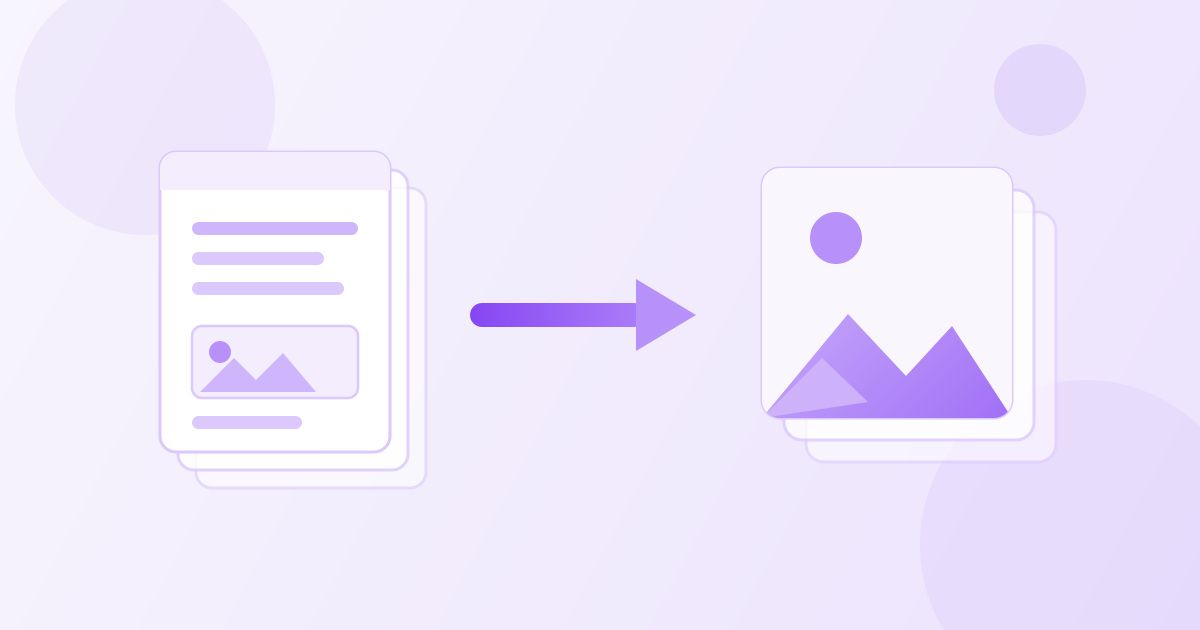
To turn a PDF into JPG images, open a browser converter like the PDF to JPG tool, upload the file, and download the result. Every page comes back as its own JPG, and if the PDF has more than one page you get them together in a ZIP. It is free, there is no watermark, and you do not need Acrobat or any installed software.
That is the whole job for most people. The part worth understanding is what you lose in the swap: a JPG is a picture of a page, not a document. The text stops being selectable, searchable and editable the moment it becomes pixels. That is exactly what you want when you are posting a page to Instagram or dropping it into a slide, and exactly what you do not want when someone still needs to copy an address out of it.
Convert a PDF to JPG in three steps
- Open the PDF to JPG converter and drop your PDF onto the upload area.
- Wait for the pages to render. A short document takes a few seconds; a long one with heavy graphics takes longer.
- Download the images. One page gives you a single JPG. Several pages arrive as a ZIP that your phone or computer can unpack without extra software.
It works the same on a phone as on a laptop, which matters more than it sounds — this is a task people usually hit on their phone, halfway through filling in a form that only accepts images.
Why people convert PDFs to images at all
The requests are surprisingly consistent:
- An upload form that rejects PDFs. Plenty of job portals, visa applications and insurance claim forms accept JPG or PNG only.
- Social media. Instagram, Facebook and LinkedIn feeds do not display a PDF. A menu, a flyer or a certificate has to become an image first.
- Slides and documents. Dropping a JPG of a page into PowerPoint or Google Docs is far easier than trying to embed a PDF and hoping it renders.
- Previews and thumbnails. A website that needs to show what a downloadable PDF looks like needs an image of page one.
- Sending one page, not twenty. Sometimes a single page as a photo is all anyone wanted.
JPG, PNG or leave it as a PDF?
Choosing the format on purpose saves a second round of conversions later.
| Format | Best for | Trade-off |
|---|---|---|
| JPG | Photos, scans, anything going to social media or an upload form | Text becomes pixels; heavy compression softens fine type |
| PNG | Screenshots, diagrams, line art, pages that need transparency | Much larger files for a full page of content |
| Anything that must stay searchable, printable or signable | Not accepted by image-only uploads or feeds |
For a full page of mixed text and graphics, JPG is almost always the right answer. If the page is a clean diagram on white and you want crisp edges, PNG serves it better — and you can convert a JPG onward with the JPG to SVG converter if you need a scalable version for print or a cutting machine.
Converting only the pages you need
Turning a 40-page report into 40 JPGs when you wanted page 12 is a waste of your time and your download quota. Trim first, convert second.
Use the PDF splitter to pull out a page range — you can enter something like 1-3,7 — and then run that short PDF through the converter. Two steps, but the second one finishes almost instantly and you are not hunting through a ZIP full of files you did not want.
If the pages come out sideways because the original was scanned in landscape, fix the orientation first with Rotate PDF. The rotation is baked into the file, so the exported images inherit it and you do not have to rotate every JPG by hand afterwards.
Getting the file size right
Page images are bigger than people expect. A dense A4 page can land anywhere from a few hundred kilobytes to several megabytes depending on how much artwork is on it. That is fine for a slide deck and a problem for a form with a 2 MB cap.
When the images are too heavy, run them through the image compressor. For a page of text and simple graphics you can usually cut the size substantially before anything looks different on screen. Compress once, check the result at full zoom, and stop there — repeatedly recompressing a JPG stacks up artefacts around letters.
If the requirement is dimensional rather than about weight — "upload a 1080 x 1080 image" — the image resizer sets exact pixel width and height, and the image cropper has presets for the common social aspect ratios so you are not guessing at the numbers.
Going back the other way
Conversions rarely travel in one direction for long. Once someone has the JPGs, the next request is usually "can you send that as one file?" The Image to PDF converter takes a set of images and assembles them into a single PDF in the order you arrange them.
Be clear-eyed about what that round trip costs: PDF to JPG and back again gives you a PDF full of pictures. The text is not selectable and not searchable, and the file is usually larger than the original. If you still have the source PDF, use it. If all you have is images of a page and you need the words out of them, the image to text tool reads printed English text out of images and scanned PDFs and gives you something you can copy.
Problems people run into
The images look blurry. Usually the PDF itself contains a low-resolution scan — the converter can only render what is in the file. A page that was scanned at a low setting will not sharpen up by becoming a JPG.
The text is no longer selectable. Expected, not a fault. Pixels have no text layer. Keep the PDF if anyone downstream needs to search or copy from it.
The download is a ZIP and the phone will not open it. Recent versions of iOS and Android unzip a file when you tap it in the Files app. If yours does not, unzip it on a computer, or split the PDF down to a single page first and get a plain JPG back.
The pages come out in an odd order. They are named by page number. Sorting a folder alphabetically can put page 10 before page 2 — sort by name with numeric ordering, or just check the numbers before you send anything on.
About your files
Be realistic about how browser tools work. Your PDF is uploaded to Toolyfied's server so the pages can be rendered, then the images are sent back to you. The file is used only to produce your result, and old files are cleared from the server automatically every day. Nothing is watermarked and no account is required — but for a document with genuinely sensitive contents, the safest approach with any online converter is to remove or redact the parts that do not need to travel first.
The short version
Upload the PDF, download the JPGs, and pick the format on purpose. Split the file first if you only want a couple of pages, fix the rotation before converting rather than after, and compress or resize the output to whatever the destination actually asks for. The conversion itself takes seconds; the two minutes of thought around it are what stop you doing the whole thing twice.
Frequently Asked Questions
How do I convert a PDF to JPG for free?
Upload the PDF to a browser tool such as Toolyfied's PDF to JPG converter and download the result. Each page comes back as its own JPG, and multi-page PDFs arrive as a ZIP. There is no cost, no account and no watermark.
Will converting a PDF to JPG reduce the quality?
JPG uses lossy compression, so there is some quality loss, though at normal settings it is not visible on screen for a page of text and graphics. The bigger change is structural: the text becomes pixels, so it can no longer be selected, searched or edited.
Can I convert just one page of a PDF to JPG?
Yes. Split the page out first with the PDF splitter — you can enter a range such as 1-3,7 — then convert that short PDF. You get exactly the images you wanted instead of a ZIP full of pages you have to sift through.
Why did my PDF download as a ZIP file instead of a JPG?
Because the PDF had more than one page, and a ZIP keeps the whole set together in one download. Tapping it in the Files app on iOS or Android unpacks it. If you only need one page, split the PDF first and you will get a plain JPG.
Should I convert to JPG or PNG?
JPG suits full pages, photos and scans, and produces much smaller files. PNG suits screenshots, diagrams and line art where crisp edges matter, and where you may need transparency. For a normal document page, JPG is the practical choice.
Can I turn the JPGs back into a PDF afterwards?
Yes, with an image to PDF converter, which assembles the images into a single PDF in the order you arrange them. Remember that the result is a PDF of pictures — the text is not searchable — so use the original PDF instead when you still have it.