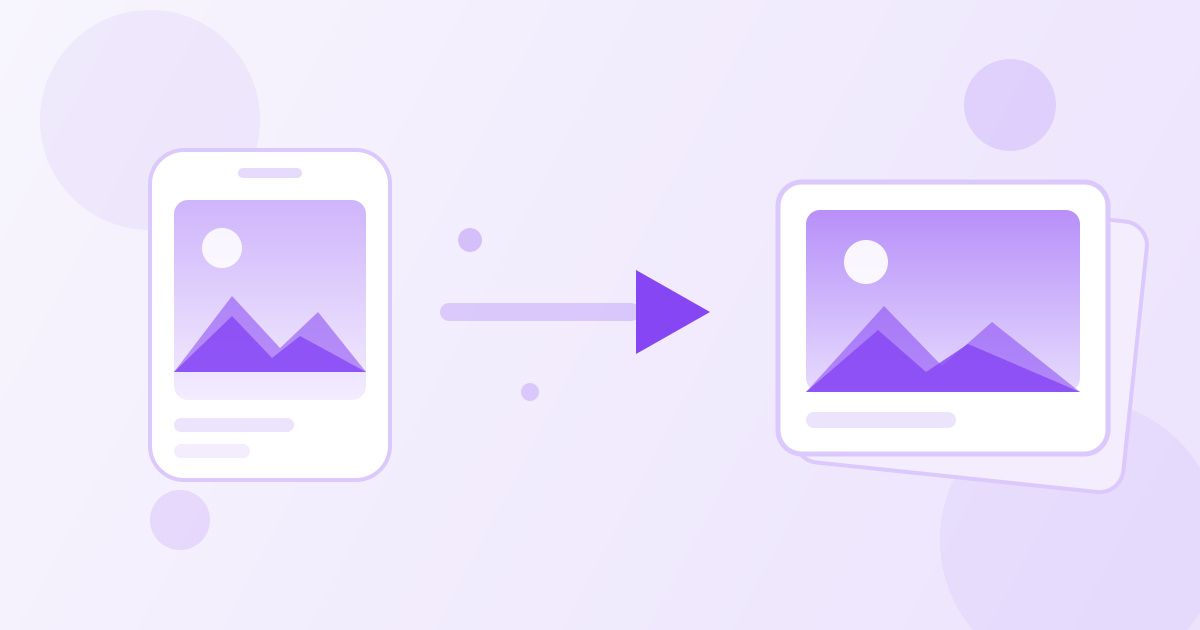
You AirDropped a few photos to a friend on Windows, or attached them to a form, and the file came back as unopenable: a .HEIC file that Photoshop shrugs at, the upload box rejects, and half the people you send it to cannot preview. Nothing is broken. Your iPhone simply saves pictures in Apple's newer HEIC format instead of JPG, and a lot of software still has not caught up.
The fix takes about ten seconds: run the file through a converter and you get an ordinary JPG that opens on any phone, laptop, printer or web form. Drop the photo into Toolyfied's HEIC to JPG converter, wait for it to process, and download the result. It is free, needs no sign-up, and adds no watermark. Below is what HEIC actually is, when converting is worth it, when it isn't, and how to stop your iPhone producing HEIC files in the first place.
What a HEIC file is
HEIC stands for High Efficiency Image Container. Apple made it the default camera format in iOS 11, back in 2017, and every iPhone since has shot HEIC unless you changed a setting. It uses a newer compression method than JPG, which is why a HEIC photo is usually around half the size of a JPG of comparable quality. It also carries things JPG cannot: wider colour depth, HDR information, and the ability to hold several images in one file, which is how Live Photos and burst shots are stored.
The trade-off is compatibility. JPG has been universally supported for three decades. HEIC is supported by Apple devices, recent versions of Windows with the right codec installed, and a growing but incomplete list of apps. If a site or a program refuses your photo, it is almost always this — not a corrupted file.
HEIC vs JPG at a glance
| HEIC | JPG | |
|---|---|---|
| File size | Roughly half of a comparable JPG | Larger for similar visual quality |
| Opens everywhere | No — Apple devices and newer software | Yes — effectively universal |
| Colour and HDR | Supports 10-bit colour and HDR data | 8-bit colour, no HDR |
| Multiple frames in one file | Yes (Live Photos, bursts) | No |
| Accepted by upload forms | Often rejected | Almost always accepted |
| Good for | Storing photos on your iPhone | Sharing, printing, uploading, editing anywhere |
Read that table as a workflow rather than a winner: keep shooting HEIC if you like the storage saving, and convert the specific photos you need to send.
How to convert HEIC to JPG
- Get the HEIC file onto the device you are working on. On iPhone, share it to Files or email it to yourself; from a Mac, drag it out of Photos; on Windows, copy it off the phone over USB.
- Open the HEIC to JPG converter and drop the file in. It accepts .heic and .heif, up to 50 MB per file, which is far more than any phone photo needs.
- Wait for the conversion to finish, then download the JPG.
Files you upload are used only to produce your result and are cleaned off the server automatically every day. Still, treat any online tool the way you would treat an email attachment: for photos of passports, bank statements or medical records, use software on your own machine instead.
Does converting lose quality?
Technically yes, because JPG is a lossy format and the picture is re-encoded when it is written. Practically, at the quality settings a normal converter uses, the difference is invisible on a phone screen, a laptop and an ordinary print. What you will notice is the file size going up, since JPG needs more bytes to hold the same detail.
Two things genuinely do not survive the trip. HDR data flattens to standard dynamic range, so a photo shot in very bright light may look slightly less punchy on an HDR display. And a Live Photo becomes a single still image, because JPG cannot hold a sequence of frames. If you care about either, keep the HEIC original and treat the JPG as the shareable copy.
One habit worth keeping: convert from the original HEIC every time, rather than converting a JPG that was itself converted from something else. Every re-encode of a lossy format costs a little detail, and those losses stack.
After converting: size, dimensions, and PDFs
A converted JPG is often bigger than you expected, which matters when a form caps uploads at 2 MB or an email bounces. Run the JPG through the image compressor and you can usually cut the size dramatically with no visible difference — that is normally enough to get under an attachment limit.
If the problem is dimensions rather than bytes — a portal asking for a photo no wider than 1000 pixels, or a profile picture that has to be square — the image resizer sets exact pixel width and height, and the image cropper handles framing with ready-made social aspect presets.
And when the photo is really a document — a signed form, a receipt, an ID you were asked to scan — the receiving office usually wants a PDF, not an image. Convert the JPG with the image to PDF converter, and if you have several pages, join the resulting PDFs into one file with the PDF merger.
Stop your iPhone making HEIC files
If you convert HEIC photos every week, change the source instead. On your iPhone open Settings, go to Camera, then Formats, and choose Most Compatible. New photos are saved as JPG from that moment on. The setting does not touch photos you have already taken, and it does cost storage: expect your camera roll to grow noticeably faster.
There is also a second, easier-to-miss setting. Under Settings → Photos, scroll to Transfer to Mac or PC and pick Automatic. With that on, photos are converted to JPG as they copy across over USB, while staying HEIC on the phone. It is the best of both worlds if your main pain point is moving pictures to a Windows machine.
Other ways to open HEIC without converting
- Windows 11 and 10: the Photos app can open HEIC once the HEIF image extension from the Microsoft Store is installed. Fine for viewing, but it does not help when an upload form rejects the format.
- Mac: Preview and Photos open HEIC natively. Right-click a file in Finder and use Quick Actions to convert it there.
- Google Photos and iCloud: both will hand you a JPG when you download a photo through a browser, which is a handy workaround for one or two files.
- Email: Mail on iOS often converts attachments to JPG on the way out, so a photo you emailed yourself may already be a JPG.
These help when you only need to look at a picture. When something else needs to accept it — a job application portal, a print shop, an older editing program — converting to JPG is still the reliable answer.
What about a whole album of photos?
An online converter handles one file at a time, which is perfect for the two photos an estate agent needs and tedious for a holiday album. For bulk work, fix the source rather than the symptom: turn on Transfer to Mac or PC → Automatic so every photo arrives on your computer as a JPG, or switch the camera to Most Compatible so new shots are JPG from the start. Photos already on the phone stay HEIC either way, so a converter is still the tool for the handful you need right now.
If the batch is going somewhere specific — a shared album, a client, a printer — decide the destination first. A print shop usually wants full-resolution JPGs. A web page wants compressed ones. A submissions portal usually wants a single PDF. Sorting that out before you convert saves doing the job twice.
A quick checklist
- Photo will not open or upload → convert it to JPG.
- JPG is too heavy for the form or the email → compress it.
- Wrong dimensions → resize, or crop to the aspect ratio you need.
- They asked for a document → turn it into a PDF, and merge multi-page sets.
- This keeps happening → switch your camera to Most Compatible.
None of the tools above need an account, and none stamp a watermark on your file. Convert the photo, get on with what you were actually doing.
Frequently Asked Questions
Why are my iPhone photos saved as HEIC?
HEIC has been the default iPhone camera format since iOS 11. Apple chose it because it stores a photo in roughly half the space of a comparable JPG while supporting wider colour and HDR. You can switch back to JPG in Settings, under Camera then Formats, by choosing Most Compatible.
How do I convert HEIC to JPG for free?
Upload the file to Toolyfied's HEIC to JPG converter and download the JPG it returns. It is free, works in any browser on phone or desktop, needs no sign-up and adds no watermark. Files are accepted up to 50 MB and are cleaned off the server automatically every day.
Will converting HEIC to JPG reduce the quality?
JPG is a lossy format, so the image is re-encoded, but at normal quality settings the difference is not visible on screen or in an ordinary print. What does change: HDR information is flattened, and a Live Photo becomes a single still frame. Keep the HEIC original if you need either.
Why is my JPG bigger than the HEIC it came from?
That is expected. HEIC uses newer compression and packs the same picture into far fewer bytes than JPG can. If the resulting JPG is too large for an email or an upload form, run it through the image compressor to bring the size down without a visible quality drop.
Can I open HEIC files on Windows without converting them?
Yes, if you install the HEIF image extension from the Microsoft Store, the Windows Photos app will display HEIC files. That solves viewing only. Websites, print services and older editing software that reject the format will still reject it, so converting to JPG remains the practical fix.
What is the difference between HEIC and HEIF?
HEIF is the underlying container standard and HEIC is Apple's implementation of it, using HEVC compression. In everyday use they refer to the same kind of file, and a converter that accepts .heic will normally accept .heif as well.