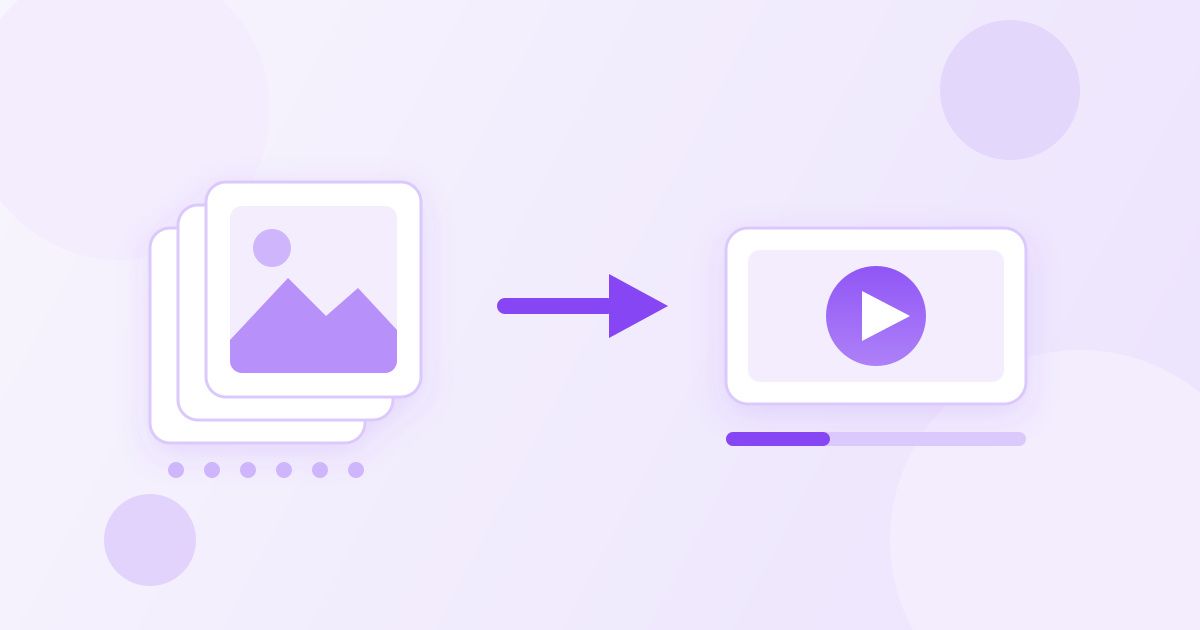
If Instagram rejected your GIF, or your 12 MB reaction clip is too big to send, the fix is the same: convert it to MP4. Upload the file to the free GIF to MP4 converter, wait a few seconds, and download a video that plays anywhere a GIF does not — usually at a fraction of the size. No sign-up, no watermark.
This guide covers why social apps refuse GIFs, how much smaller MP4 really is, what you lose in the swap, and what to do when the result plays once instead of looping.
Why Instagram and TikTok will not take your GIF
GIF is a 1987 image format that happens to support animation. Every social platform that shows you "GIFs" — the Instagram sticker drawer, the WhatsApp GIF button, X's autoplaying clips — is actually showing you an MP4 or WebM video behind the scenes. They convert on their end, or they source the clip already converted from a GIF library. What they do not do is accept a raw .gif file from your camera roll as a post.
So when you try to upload a GIF and the app says the file type is unsupported, or silently ignores it, nothing is broken. You are handing a video-shaped file to a photo-and-video uploader that only speaks MP4 and MOV. Convert it first and the upload behaves like any other clip.
The same applies in more places than people expect:
- Instagram feed, Stories and Reels — video only.
- TikTok — video only.
- YouTube and YouTube Shorts — video only.
- Most video editors — many will import a GIF, but plenty choke on it or drop the frame timing.
- Presentation software and website builders — will often take a GIF, but the page then carries the file-size cost on every load.
The size difference is the real reason to convert
GIF has no modern video compression. It stores animation as a sequence of full frames, each limited to a 256-colour palette, with only simple frame-to-frame optimisation. MP4 uses H.264, which describes what changed between frames instead of redrawing them. For a clip with a mostly static background — which is what nearly every reaction GIF is — the difference is dramatic.
Exact savings depend entirely on the clip, so treat any single percentage you read as marketing. What is reliably true is the shape of the difference:
| Property | GIF | MP4 |
|---|---|---|
| Colours | 256 per frame | Millions |
| Compression | Per-frame, lossless palette | H.264 inter-frame |
| Typical file size | Large — often several MB for a few seconds | Much smaller for the same clip |
| Audio | Not supported at all | Supported |
| Loops by default | Yes | Depends on the player |
| Accepted by Instagram / TikTok | No | Yes |
That size gap matters beyond social apps. A GIF embedded in a web page is downloaded in full before it plays, so a heavy one delays everything below it. Swapping the GIF for an MP4 and letting the browser stream it is one of the cheapest page-speed wins available on a content-heavy site.
How to convert a GIF to MP4
- Open the GIF to MP4 converter.
- Select your .gif file, or drag it onto the page. It works the same on a phone browser as on a laptop.
- Let the conversion finish. Short clips take a few seconds.
- Download the MP4 and upload it wherever the GIF was refused.
The tool is free, needs no account, and adds no watermark. Your file is used only to produce the result, and old files are cleaned off the server automatically every day.
What changes when you convert
The swap is not perfectly lossless in either direction, and it helps to know what shifts.
Colours usually improve. A GIF was already crushed down to 256 colours, and MP4 does not restore what was thrown away — but it will not throw away any more. Gradients that looked banded in the GIF will look about the same, not worse.
Transparency does not survive. GIF supports a single fully transparent colour. MP4 has no alpha channel in any form that ordinary players and social apps understand. If your GIF had a transparent background, the video will show it as a solid colour. For a logo or cut-out that genuinely needs transparency, keep a still PNG version too — a background remover will produce one from a frame if you do not have the original.
Looping becomes the player's decision. A GIF carries a loop instruction inside the file. An MP4 does not, so whether it repeats depends on where you post it. Instagram, TikTok and X loop short videos automatically. A raw MP4 opened in a desktop player generally plays once. On your own website, add the loop attribute to the video tag.
There is still no audio. Converting to MP4 gives the file the ability to carry sound, but a GIF never had any, so the output is silent. Some platforms flag silent video oddly; adding a quiet track in a proper editor solves that if it matters.
Going the other direction, and the tools around it
Plenty of people arrive at this problem from the opposite side — they have a video and need a GIF for a forum, a Slack channel or an email signature that will not embed video. The video to GIF converter handles that, and the same trade-offs apply in reverse: expect the GIF to be considerably larger than the clip you started with.
Two neighbouring jobs come up constantly with both:
- The clip is too long. Trim before you convert, not after — a shorter source produces a smaller file in either format. The video trimmer cuts by exact start and end times and keeps the original quality.
- The MP4 is still too big. This happens with long or high-resolution GIFs. Run the result through the video compressor to bring it under an upload limit without a watermark.
Three problems that show up after converting
The video looks softer than the GIF did. This is usually a resolution problem rather than a compression one. Many GIFs are tiny — 320 pixels wide is common, because that is what the format was practical at — and a social app will stretch that to fill a phone screen. The MP4 did not degrade anything; you are simply seeing a small image enlarged. Nothing can recover detail that was never captured, so if the clip matters, go back to the original video and export from that instead of from the GIF.
The aspect ratio gets cropped. Social platforms expect specific shapes — roughly square for a feed post, tall for Stories and Reels. A wide GIF dropped into a vertical slot gets letterboxed or cropped at the sides, sometimes right through the part that matters. Check the framing in the app's preview before you post, and crop deliberately rather than letting the platform decide for you.
The first frame looks wrong as a thumbnail. A GIF has no concept of a cover image; a video does, and most platforms grab an early frame for it. If your animation opens on a blank or dark frame, that becomes the still everyone sees in the feed. Trimming the first fraction of a second off the front is the quickest fix, and it costs you nothing visually since the clip loops anyway.
Picking the right format for the job
A short decision guide, because "always use MP4" is not quite right:
- Posting to a social feed — MP4, every time. It is the only thing that will upload.
- Embedding on your own site — MP4 in a muted, autoplaying, looping video tag. Far lighter than a GIF.
- Email, forums, chat tools with no video support — GIF is still the pragmatic answer, because it renders as an image.
- Anything needing a transparent background — neither. Use a still image, or a proper animation format your platform supports.
Once the file is an MP4 it behaves like any other video, which means every ordinary video tool applies to it. That is really the point of converting: a GIF is a dead end, and an MP4 is a file you can keep working with.
Frequently Asked Questions
Why can't I upload a GIF to Instagram?
Instagram's uploader only accepts video and photo files, not .gif. The animated "GIFs" you see in Stories and the sticker drawer are actually short videos that Instagram converted on its own servers. Convert your GIF to MP4 first and it uploads like any other clip.
Is MP4 smaller than GIF?
Almost always, and often by a lot. GIF stores each frame separately with only a 256-colour palette, while MP4's H.264 compression records what changed between frames. The saving is biggest on clips with a mostly still background, which describes most reaction GIFs.
Does converting a GIF to MP4 lose quality?
Very little that you will notice. The heavy quality loss already happened when the animation was made a GIF and squeezed into 256 colours. MP4 will not restore that detail, but it will not remove much more either.
Will my MP4 still loop like the GIF did?
That depends on the player. A GIF stores a loop instruction in the file itself; MP4 does not. Instagram, TikTok and X loop short videos automatically, and on your own website you add the loop attribute to the video tag. A desktop media player will usually play it once.
What happens to a transparent GIF background?
It is lost. MP4 has no alpha channel that ordinary players and social apps can use, so a transparent background becomes a solid colour in the video. If you need transparency, keep a still PNG version of the image alongside the video.
Is the GIF to MP4 converter free, and does it add a watermark?
It is completely free with no account required, and it adds no watermark to the output. Your file is used only to produce the MP4, and old files are removed from the server automatically every day.